Monday, February 04, 2008

Winter Ramp


Obviously there was a methodical approach to the Peach Peloton distances since November. I didn't realize until I glanced at my season TSS and mileage charts that with the exception of a couple of December blips, we had a pretty smooth ramp from 50 miles/ride to 125 miles/ride throughout the winter.

Monday, January 21, 2008

FTP update

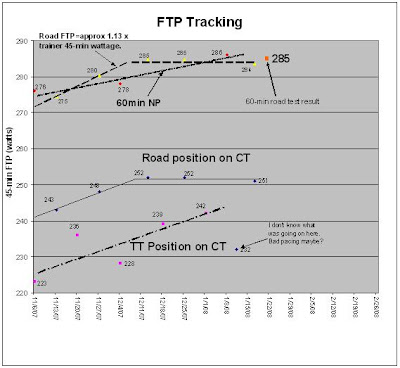
I finally did a 60-min FTP effort -- below is the updated FTP chart. As it turns out, the best way for me to predict my FTP without actually doing a 60-min TT effort is with 60-min NP. I guess that's close to proof that Coggan's normalized power formula works extremely well (for me at least). I can also use 45-min computrainer x 1.13.

The crappy part is that I had to go back to December 11th and update my FTP in WKO. That knocked my CTL down about 3 points.

Thursday, January 17, 2008

Le Plateau

My graph has hit a flat spot. The numbers climbed steadily for the first 6 weeks of base training, then leveled off.

I feel good and pretty fresh - definitely not overtrained. And since I've included more intense work into my training lately, my 60-min Normalized Power continues to rise (280w 60-min NP was the highest I hit in all of 2007). But my max wattage for 45-min on the Computrainer has plateaued.

Maybe the L5 intervals I'm doing now will bump up my VO2 max a little, 'raise my FTP ceiling,' and provide me with another FTP bump in a month or two -- we'll see. I think I remember the same thing happening last year, but there's not much data to verify it. I may do a 60-min road FTP session next week to see where the gold standard test puts me.

Sunday, January 13, 2008

Variations in Pro TT Positions

All these guys are world-class time trialists (except Jordan, he's a Fred.)

Their positions are very different in some respects. Armstrong and Ullrich forego aggressive positions and rely on their power for speed. (Armstrong's saddle is 22cm behind the BB/Ullrich's is 18). Vino wasn't a great time trialist in 2006. Their trunk angles are in the 13-degree range, as was mine in Rome in September. Someone told me they thought Armstrong looked like a piece of plywood rolling down the road.


Cancellara, Zabriski, and Vinokurov-2007 all have very aggressive positions (7-10cm from saddle to BB). They're trunk angles are all 6-7 degrees from the horizontal, very aggressive and effective in making you faster if you can generate power in that position. Vino worked on his TT position between 2006 and 2007 and it showed in his TT results (although he might have had more help than just a more agressive position). If you look closely in my picture, you can see that I have my forearms resting directly on the bar, not on the arm pads. If I want to achieve this position, a-la Zabriski, I'll need to go bar shopping. I have no idea how much power I could put out in that position or how it would change my CdA, but I can and will test both.


Then you have Leipheimer and Landis. Their trunk angles are 8-11 degrees (semi-agressive), but their upper arm angles are in the 78-80 degree range, unlike the 88-93 degree range of most others. Maybe that gives them leverage to generate more power?

But one thing common among them all - the angles formed by their bottom brackets, their hip joints, and their trunks are all very near 90 degrees. So if you want to lower your bars, you have to move your seat forward to compensate.

Wednesday, January 09, 2008

Alex Simmons' Coggan Levels graphic

You might have already run across this at Google Wattage, but I thought I'd post it here because it's such a great graphic representation of the Coggan Power Levels and their physiological responses. The graphic was created by Alex Simmons from down under. His blog can be found at Alex's Cycle Blog.


Sunday, January 06, 2008

Double Plays and "Flipping the Switch"

Ok, forgive me for a few minutes while I try to sound authoritative on a subject where I'm not. (I could have shortened this post and made my point quickly, but I've decided on a longer version, so bear with me.)

I used to play baseball. From age 5 to age 13 or 14 (when I discovered golf), baseball was a big deal. I was pretty good at fielding ground balls, but didn't have a strong arm - that meant I played 2nd base instead of shortstop, where I wanted to be... but I digress.

In baseball practice, we would often work on a very specific single task for a while, like fielding ground balls, or "taking grounders". Then after a while, we'd move on to work on another task, like "throwing it around," which involved moving the ball around the infield in a circle as quickly as possible. Later in practice, we'd put it all together and practice fielding ground balls, then 'turning two' for a double play. You had to successfully combine the two skills to get the job done.

Winter bike training is like that. In November and December, I put in hours on the trainer or the road attempting to target and improve specific energy systems. I do long L2/L3 rides to teach my body to burn glycogen and fat efficiently. I endure 45-minute steady L4 intervals to increase my capillary density, to improve my cardiac output, and to grow more efficient mitochondria. This week (early January), I'll start doing 5-minute VO2max intervals to try and raise my FTP 'ceiling' and teach my muscles cells to buffer lactic acid. Soon I'll be doing 1-minute hard efforts to try and teach my body to better use the pure anaerobic system. For the most part, those goals are targeted in separate workouts on separate days.

But yesterday in the three 15- to 30-minute Attack Zones that were part of our 5-hour group ride, I was reminded how important it is to be able to shift from one energy system to the next and then recover and go back again. Rarely in competition are we able to stay powered by one energy system for an extended time (time trials and sitting in the back of a large peloton are the most obvious exeptions). Racing often requires attacking off the front, bridging to another group, following a surge, or pulling a teammate, followed by sitting in and trying to recharge for another effort. And as I was reminded yesterday, the difference between being able to semi-recover in 10 seconds instead of 15 can sometimes make all the difference.

Each of those mini-efforts could be thown into it's appropriate bin labelled L3, L4, L5, L6, or L7. But put them together in a 30-minute race effort, and the sum of the parts becomes a different thing. It's like turning a double play when you've been taking grounders all winter. There is obviously skill involved in the double play, and likewise, practicing racing has it's obvious benefits, tactical and otherwise. But (here's where I'm going out on a limb) I'm guessing that there are physiological mechanisms of some sort involved in the quick switch from one energy source to another and then back again; and that the transition can be improved by training it.

So here's my thesis: Training each energy system alone isn't enough to maximize your ability. You need to specifically target and train the transition mechanisms also.

You need to prepare for the trip from L3 across your threshold to put in a large L6 effort, then sit on a wheel for 15 seconds at L3/L4 to clear the lactate, then bridge for 2 minutes at L5, then hang on at L3/L4 to rest for 60 seconds, then sit in on a short climb at L5, then hang on at L4 for 90 seconds before sprinting at L7 to follow an attack and then do it all again.

Yesterday's efforts reminded me of a workout that Tony Myers of ATS prescribed for me a couple of years ago. He called it "Flipping the Switch." I wasn't training with power then. The workout consisted of taking my heartrate from my aerobic threshold (115 bpm for me) to 5 beats above my LT, then back to aerobic threshold as quickly as possible. I'd repeat the process as many times as I could in a 30-minute session using repeats on a short hill or a hill-repeat loop on the computrainer. It's a brutal workout physically and psycologically. As Tony told me: "Your body doesn't like to switch energy systems." He's right. I guess switching systems is probably an inefficient use of the body's energy, and evolution has resulted in us not liking it very much.

So after you've trained each system through the winter, make sure to Flip the Switch through practice racing, or interval sessions, to be ready for race conditions.

Friday, January 04, 2008

A One-Trick Pony

I made the decision early last winter to hit the weights as a part of my off-season cycling training. I'd lifted before, primarily upper body stuff, and it had made a big improvement in my swimming ability when I was doing triathlon. I'm not a mesomorph - the kind of guy who can lift a cup of coffee and have his biceps grow two inches. I get stronger very quickly early in a lifting program, but don't gain much mass. So I thought squats, leg extensions, leg curls, step-ups, etc. would benefit my cycling.

I did make lots of cycling improvement last winter, and it seemed that the squats were a good idea at the time; but in retrospect I think almost all of my cycling improvement was aerobic and due primarily to longer winter rides and more riding in general.

This year I've eschewed the weights and used that time to ride hard instead. I've added sprint intervals and some low-cadence work into mid-week workouts to replace the anaerobic work I was doing in the weight room. There is no doubt in my mind that eliminating weights was a good call.

Like Dr. Coggan says, "Specificity, specificity, specificity" and "It's an aerobic sport, damn it!" So if you want to be better at riding your bike, then ride your bike. Ride Lots. Be a one-trick pony.

Monday, December 31, 2007

TT Trunk Angle

Copied from http://biketechreview.com/performance/pareto.htm:

"Getting the trunk angle lower can have a significant impact on aerodynamics and performance as summarized in the “rule of thumb” table below (values generated using a mathematical model which uses an average power constraint to determine the optimal pacing strategy for a given TT course):

Table 1. Cherry Creek TT performance and how it is affected by trunk


This is how trunk angle is defined.


It looks like I'll need some new bars (and maybe some yoga lessons) to get to 8 percent trunk angle or better:

I know it doesn't look like it in the photo, but this position actually feels very agressive on the bike. It feels like I'm way out over the front wheel. The ninja-dude's position must feel like he's sitting on the front wheel.

The time listed with each angle is the time saved on a 40K TT IF POWER IS CONSTANT. That's a big IF with extremely aero positions.

Thursday, December 27, 2007

CTL

This is an overview of my CTL (chronic training load) since Spring 2006, when I started training for bike races:


I read somewhere that for steady, long-term CTL building, you should aim for a CTL each November that equals your prior year's April CTL. Even without specifically trying to do that, I have fit into that pattern over the last two years.

Another interesting item: October was my off month (I rode a little, but didn't train). My CTL constant is set at 42 in Performance Manager, and my current CTL (12-26-07) is 81.6. If I had done a 125TSS workout on October 15th, almost 75 days ago, my CTL would now be 82.1, half a point higher. It's a common misconception that if your CTL constant is set at 42, then only the last 42 days of TSS data will contribute to your current CTL, but that's not true. I believe CTL is calculated using a radioactive decay equation where 42 would be the half-life of the TSS generated in the past. So the older TSS points don't count as much, but they still have an effect. So my October off time is still having an effect on my current CTL.

Monday, December 24, 2007

Merry Christmas!

1972

Wednesday, December 19, 2007

FTP Improvement

The plan is working..... but can I maintain the progress? We'll see.


(From empirical evidence, I know that my road FTP is 106% of my 45min power on the Computrainer).

Sunday, December 16, 2007

What's the Point?

Several folks have asked me: "What's the purpose of your winter training plan? I know it's important to ride lots in the winter, but what exactly are you trying to accomplish?" It's a simple question, but it got me thinking about exactly what I want the plan to do to my body, so here's my best shot at explaining it:

In reading this, it might be helpful to reference the 2008 Winter Training Plan and Coggan's energy systems table.

Winter training goals, sort of prioritized:

  1. Increase L4 - FTP (functional threshold power). During the racing season, and particularly towards the end of the racing season, I usually find myself either recovering, riding 1 to 2 hour hard group rides, or doing short, intense races lasting from 30 minutes to 2 hours. Recovery is a requisite, and there are many benefits to hard group rides and races, but neither is great for increasing FTP. By late season my aerobic engine needs maintenance. By the end of my off-month (October) this year, my FTP had fallen by about 20 watts to 260 watts from my season peak of about 280, which occurred in July or August. Nine base weeks of mostly L2/L3/L4 work including at least one long (3.5-4.0hr+) group ride will rebuild my FTP. Since November 1st, I've measured a steady FTP increase of 2.25 watts per week. If I can keep up that rate of increase, I'll be back to last year's peak of 280 watts by the end of the nine-week winter base training period. I'll start the year with last year's peak number - a larger base on which to build the season.
  2. Build Chronic Training Load. My CTL had dropped to about 70 TSS (total stress score) at the end of October. I want my CTL to be at least 100 when the racing season starts, and I probably should build it to around 110 if possible before the 5-day, 8-stage Tour of Atlanta in May. One of the best ways to increse CTL is by doing 4.5-hour Peach Peloton rides every Saturday that routinely deliver between 250 and 350 TSS points. TSS=(NP/FTP)^2 x 100 x hours. A good rule of thumb to make steady year-to-year progress: raise CTL each November to the level of the prior April.
  3. Regain/maintain endurance ability (L2/L3). The absence of frequent long rides during the season might diminish my ability to ride comfortably at L2 or L3 pace for 4 to 6 hours. The long Saturday rides in my winter plan reestablish and strengthen whatever biological systems enable me to do that. To be honest, I'm not sure exactly how those endurance systems differ from the ones involved in 45min FTP workouts, but I'm sure there are differences. (Probably fat burning ability vs glycogen burning ability?). Being able to ride comfortably at L3 for 5 hours isn't critical for a cat4 bike racer who's races rarely exceed 40-50 miles in length. But the BBQ Bass Ride and the Six Gap Century are more than 50 miles long and I'd like for them to be fun.
  4. Maintain/develop L7 - neuromuscular (NM) sprinting ability. I'm no sprinter. But I've recently learned that a little sprint training goes a long way. I've increased my sprint from about 950w max to 1160w max in 10 weeks with only eight 15sec sprint intervals per week. I think most of that increased power comes from establishing muscle memory and NM adaptations. If you've ever started lifting weights from scratch, you know how much progress you can make in the first month or two - an awful lot. Most of that initial increase comes from teaching your brain and nervous system how to lift the weight - not from larger or stronger muscles. Your nervous system has an automatic governor to prevent you from injuring yourself (you've read about crisis situations in which people display almost superhuman strength - their brains have temporarily turned the governor off). As you do sprint intervals, your NM system slowly raises the level at which the governor will kick in (the adrenaline rush at races does the same thing). That lets you put out more wattage with the same legs. Doing one L7 workout per week during the base period maintains those adaptations so you don't have to learn them again in April. It also does a tiny bit to maintain your ability to tolerate lactic acid.
  5. Maintain ligament and tendon strength. Very simple - sprint workouts keep your ligaments and tendon's strong through the winter so they're ready for the more intense work in spring. I think this makes injuries less likely.
  6. Maintain VO2max and anaerobic systems (L5/L6). The November and December 4-hour Peach Peloton rides on Saturdays often have 20-minute attack zones. The AZs are a good way to keep the anaerobic engine from atrophying over the winter. Too much L5/L6 work in November/December and you won't have the legs or time to develop the aerobic side properly; but I think a little each week will make it easier to kick-start the VO2max (build) and anaerobic workouts in January and February.
  7. January L5 -VO2max. This is transition territory. The 5-minute interval workouts at 110% FTP in January continue to build your aerobic system, but also begin to strengthen your lactate tolerance as speed skills gradually revisited. See training level 5 in Coggan's table. L5 is not that much different that L4, but lactic acid tolerance is initiated.
  8. February L6 - Anaerobic. There is a dramatic difference in the way your body is powered when putting out L6 power compared to when it's putting out power in the L1-L5 zones (see Coggan table above). That's why you can't stay powered at L6 for very long. The 1-minute interval workouts in February develop your L6 (anaerobic/lactic acid buffering) system and prepare you for the intense race efforts required during the season.

Wednesday, December 12, 2007

Training Plan Changes


I've made some winter training plan changes - just tweaking mainly. I've been pleased with the plan so far.

See an image of the new plan to the left. I've posted it for download in Excel format at 2008 Winter Training Plan R2 in case anyone would like to use it as a template or modify it as you see fit.


So what changed?
  • I've corrected an error in the week numbers.
  • In weeks 7, 8, and 9 I've thrown in a 20-minute interval at L4 between two sets of 4 x 15 second sprint intervals. (most of my TTs are 20-min length)
  • I changed all Wednesday 2hr L2 workouts to 1.5 hours of L3 (I'm convinced the benefit is the same or more and it saves time).
  • I changed all Monday 1hr L1 workouts to 45min at L2 (same reason as above). If I feel that I really need the recovery day, I'll just take the day off.
  • In weeks 10-13 I've moved my FTP tests to Thursday and included a FTP test every week instead of every other week.
  • I updated some of the TSS numbers for Peach Peloton rides to be more realistic. I was assuming 225 to 250 TSS for those rides and I've routinely generated over 300 TSS.
  • I added the Pine Mt. Challenge
  • I added the Race Around Macon
  • I added the Tundra Time Trial.

Monday, December 10, 2007

Winter L4 work on TT bike - yes or no?

I'm of the opinion that alternating from road bike to TT bike for my weekly 45-min power test is a good way to improve my power on the TT bike for spring. And even if my power is slightly lower in TT position, I think I still get great benefit from a physiological perspective.

A few contributors to Google Wattage and a friend of mine have very different opinions. They say that I'm wasting my time by riding the TT bike in December when I should be using every valuable minute of L4 winter training to increase road bike FTP. They say I should be on my road bike for every L4 workout until February.

I think I'm going to be stubborn and continue to do every other week in TT position because I think the benefits outweigh the costs. If you have an opinion, enter it into the poll on the upper right corner of the blog.

Wednesday, December 05, 2007

Agony, Agony, Agony

Some days you just don't have it. I suffered through my 45-min test in TT position on the Cervelo last night. I never felt comfortable, constantly looking for the right cadence and getting weaker as I went. The experience was quite unpleasant. It sucked - 228 watts (that corresponds to a FTP of 242 watts for my aggresive TT position (for a variety of reasons I can generate about 6% more power on the road). Maybe next time will be better.

Friday, November 30, 2007

Cycling Frontal Area

I found this photo and thought it was interesting:

I guess whoever created this didn't have a TT bike? My guess is that TT position would be somewhere between the two recumbent photos in frontal area.

Tuesday, November 27, 2007

The Power-Equipment-Speed Relationships

I spend and awful lot of time and energy measuring my power on the bike. But power doesn't win races, speed does. For the foreseeable future, power will be the best way to track changes in fitness; and it will be the best method of structuring a training program.

But in order to step back and see the big picture or to run through various equipment scenarios, I think it's important to know:

  1. how much faster will I be on a flat TT if I increase my FTP by 20 watts, or

  2. how much time will I cut off a climb if I lose 5 pounds, or

  3. how much time will I cut off a climb if I buy a bike that's 2 pounds lighter, or

  4. how much energy (power) will I save sitting in a 25-mph paceline if I swap my Ksyriums for Zipp 404s, or

  5. if I do a solo break away with one lap to go on the rolling Augusta road race course would I go faster with my lighter box section rims or heavier but more aero deep section rims, or

  6. what will the winning gap be if I sprint with 800 watts over 150 meters against a 180-pound guy putting out 970 watts? And more importantly, who will win? And if it's not me, how many more watts do I need to win?

There are many variables involved in answering those questions, but almost all of them are measurable to a fairly high degree if you have the time, equipment, patience, and desire. I've already answered many of them for myself, but I've used different spreadsheets or methods or web sites for almost every question and situation. And those spreadsheets, methods, or web sites often make assumptions that I don't agree with or simplifications that don't apply to what I'm doing. So it's hard to be consistent across the board with answering the questions and be confident in the answers.

So I decided to create a spreadsheet that ties all the physics together to the best of my abilities. I'm well aware that I'm probably the 10,000th person to attempt this task and that it's been done by folks with a lot more knowledge that I have. My spreadsheet might be better than some and will not be as good as others you might have seen. I hope it is accurate from a physics and math standpoint, but I'm not 100% sure. If you find errors, please let me know so I can make corrections and minimize the embarrassment factor.

But if nothing else, going through the tedious process has helped me understand the physics behind the above questions better than I did before, and that's reason enough to do it.

I've named the spreadsheet Badger because all the other names I thought of were about a mile long and sounded like the title of someone's masters thesis. This is bike racing, not study hall. It's a work in progress, but if you assume a rolling resistance coefficient, you can calculate almost anything else (use Crr=0.005 if you aren't sure. There are field tests to measure Crr, and I'll work on those later).

My spreadsheet is available here: Badger

In a nut shell, this is how it works:

  • The first sheet, "CdA calc", uses your input data (weight, weather data, distance, time, slope, and assumed rolling resistance) to calculate the forces against the rider (rolling resistance, air resistance, and slope resistance). Start and finish speeds should be entered so momentum can be accounted for, but results are best when start and finish speeds are equal. All the forces against the rider are set equal to the wattage you put out (to satisfy conservation of energy), and the equation is set up to solve for your drag coefficient CdA. For coast down tests, use wattage equal 0.
  • On the second sheet, input your weight, weather data, and the CdA that you calculated from the first sheet (you have to manipulate Cd and A to get the right CdA). Use 0.40 for A if you aren't sure - as long as CdA is correct it really doesn't matter). Assume a rolling resistance coefficient (Crr). Then you can set up each segment of any course to see how changing variables such as wattage, weight, rolling resistance, and CdA will change your finish time for the entire course. If the totals on the left side of the spreadsheet show errors, just delete any cells on the right side of the spreadsheet that aren't being used and that should solve the problem.
Friday, November 23, 2007

Strange Time for New Sprint Records

My sprint power:

Old Records: ------Peak-1042w; 1s-1062w; 5s-979w; 10s-880w
Today's numbers: Peak-1149w; 1s-1119w; 5s-1061w; 10s-919w

Either the Thursday 8x15s intervals are having an effect or I have a fresher anaerobic system this time of year because I'm doing mostly aerobic work. Maybe some of both.

Thank you Otter and Badger for serving as carrots on the 1/5 second and 10 second records, respectively. I lost both sprints, but maybe I was close enough for you to hear me breathing for a change.

Wednesday, November 21, 2007

Time Trial Pacing

I've always read how important it is to pace properly in TTs. My last two FTP tests on the Cervelo are hard evidence of that fact.

Two weeks ago, I started out too hard. My first 5 minutes I averaged almost 300 watts. I ended up averaging 251 watts over 45 minutes and was completely exhausted at the end - I didn't even have a good finishing kick.

Last night I started out correctly. My first 5 minutes I averaged 263 watts. I ended up averaging 265 watts over 45 minutes. I felt better throughout the test and had a very strong finishing 5 minute push.

My motivation was pretty low last night, so I attribute the entire wattage increase to proper pacing.

Wednesday, November 14, 2007

Orbea FTP Test

Last Tuesday was a 45-min FTP test on the Cervelo in TT position on the computrainer -- average 251 watts.

This Tuesday was a 45-min FTP test on the Orbea in road position on the computrainer -- average 274 watts.

That's a 9% difference and realistically probably 10% becasue I was fresher for the TT ride. That's about the difference that I expected between the two bikes/positions. The Orbea ride was also paced much better and I felt much more powerful throughout the test. It wouldn't surprise me if my TT ride wattage next Tuesday is higher due to better pacing alone.

The unexpected part of the whole deal was finding out that my computrainer wattage is 10% higher than the wattage measured by my Ergomo (mounted on my Orbea). I'm confident that my Ergomo is accurate, and this confirms a 10% difference between the two that I found last week when testing a teammate. I thought maybe his left leg was weaker due to a prior injury (which would result in an Ergomo/CT discrepancy), but I guess not. You'd expect the computrainer number to be a little less than the Ergomo number (maybe 2-4%) because of drivetrain losses between the crank and the road, but not 10% different.

All of my Tuesday night FTP tests will be on the computrainer but not always with the Ergomo, so I'll use CT numbers in my winter-training tracking charts. Measuring change is the important part, not measuring accurate wattage. Plus using the CT numbers will make me look stronger than I actually am, which is always a bonus!

Bottom line: My road FTP is about 265 now. Hopefully when I test in early January it will be at least 280.