Monday, March 26, 2007

Gainesville GA Cup - Competitive

The weather was perfect for the road race in Gainesville on Sunday -- about 60 degrees at 8am. MAX was represented in the competitive division by me and Richard Hilton, who was trying his first road race. I like the Gainesville course because it requires a few minutes of all-out climbing effort, then gives you some time to recover before the next big effort. That's an easier thing for me than sustained effort on the flats or low hills.

The competitive class had a big field -- about 80 riders (the field limit is 75, but they let a few folks register on race morning, I think). The new start/finish was on top of the small climb that follows the Mabry climb, and it was a much better location than the downhill finish last year.

The first time (of 6) up Mabry hill (a little less than a mile at about 8 or 9%), the front group lost about 50 riders off the back. There were lots of Aarons riders and a couple of other teams had 3 or 4 riders each. After the second climb, we had about 20 or 25 riders in the front group, and two riders went off the front. They stayed out there a long time (I think at least a couple of laps), but were eventually pulled back.

The front group kept changing in size, because we'd lose 5 or 10 riders each time up Mabry hill, then some riders would chase back on by the time we reached the other side of the 10k course. At the base of Mabry on the final lap, I think we had about 18 in the group and two guys with a small lead off the front. Lots of hard accelerations strung the group out pretty good on the last climb and then we broke up into a few clusters as we approached the finishing hill. There were a few guys behind me from the front group, but not many. I finished 16th, and was very pleased with my ride. Richard did well for a couple of laps and had a good intro to road racing.

A few notes from other races:

  • Keith, Todd, and Brett from MAX rode the TT on Saturday.
  • Christian won the elite TT on Saturday, had a decent crit, picked up a few KOM bonuses in the RR, and won the General Classification.
  • Jeff rode well in the elite crit and the RR. He stayed in the front RR group for several laps, threw a chain, chased back up, drifted back on the hill, chased back up again a couple of times. I think he finished about 15th.
  • Bill, Ron, Dale, and Andy (Roadmasters) and David Parett rode hard in a Masters RR with a very tough field, but I don't know any results.
  • I think Chad finished 8th in the pro crit, then did a lot of work early in the RR.

Sunday, March 18, 2007

Training Data

I've attached some of my power training data. I find it useful for measuring progress from year to year and for training motivation, but also to see where the weak spots are in my training and/or ability.

This is my mean maximal power graph. (click on the graphs to see them better). It shows the maximum power I can hold for any given time interval. The time graph is logorithmic, the yellow line is this season, and the dashed line is last year. It's not really a valid graph because all of last year's data came from the computrainer and this year has road data and CT data.


The 2007 power graph is significantly higher than the 2006 graph for most time intervals. But the two lines are the same for the interval from about 15 seconds to about 30 seconds. Since all of my 2006 data is from training sessions on the computrainer, it probably means I did high intensity 15-30s intervals last year on the CT and either haven't done intervals in that range this year or have not improved my power in that range. It would be interesting to know which is the case, so I'll schedule some hard 20-30 second intervals this week to find out.

This is the same data, but it reflects normalized power (equivalent constant power output instead of average power). Normalized power isn't valid for short intervals, so this graph starts at about 5 minutes. I see clear improvement since last year, but the real test will be comparing 2007 data with 2008 data.

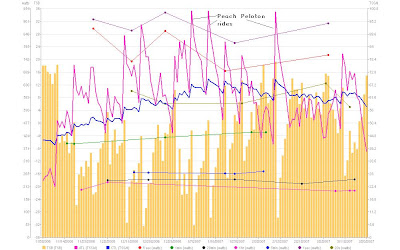
This is the most comprehensive chart. It's my performance manager chart, which reflects acute training load (ATL), chronic training load (CTL), total stress balance (TSB), and my best wattage outputs for certain time intervals.


The blue line (CTL) is the one I watch the most. It tells me my training load for the past 6 weeks. The yellow bars represent my TSB. I'd be expected to perform well when it's above 0, near +10. I can tell by the absence of any 1-minute (green) data lately that I need to do some 1-minute intervals to check my progress there. It's obvious that I need to increase my stress during the week to prevent decay of the CTL. My plan is to peak at 75 or 80 CTL in June and again in September.


Monday, March 05, 2007

Albany Georgia Cup summary - a slow crowded race

I think there were about 15 riders from the Macon area at the Albany Georgia Cup race yesterday, which is quite a change from last year, when there were typically only 3 or 4. It was windy and cool (50 degrees) at the start. The course was very flat with only a bump or two that could be called a hill.

The Pro-Am (pro-1-2-3), Elite (3-4), and Masters races started first, then the Competitive (4-5). Our field was about 90 riders. Most of us from MAX and Macon Roadmasters started somewhere in the middle of the group. Lots of slinky action early in the 31-mile route. I guess nobody wanted to pull hard that early and the group was so big and roads so narrow, that it was difficult to move up - lots of short accelerations and braking, "slowing."

I finally worked my way to the front 20 or 30 riders after a few miles into the headwind. Then we turned right and had a stiff breeze from the left. As folks started to seek cover near the right side of the road, Bill came by out in the wind on my left steadily headed for the front, so I followed. He pulled off the front a ways, I and one or two others followed. It was too early for a 1 or 2 man breakaway, but I hoped that either the extra speed would shed some of the size of the peloton or even better, that we'd get 8 or 10 aggressive co-workers and be able make some space between us and the group so that we could get away. We were joined for a while by Jake and then for a while by Todd and a few others from other teams. After 10 minutes of short punches off the front, we were making no progress and gaining no passengers, so we faded back and were absorbed by the group.

At about mile 20, I was riding beside Jake when sombody's tire popped just in front of us. I thought it was a crash that would clog the road. The guys up front heard it and accelerated. I told Jake to go, thinking it might split the group, but it did not.

Shortly thereafter, the wind hit us hard from the right. I was on the yellow line in the wind shade and Jake was in the middle of the lane. The right windy side was open for a change. I told Jake to get in the wind and we'd advance up the side of the group. He jumped out there and took off, but somebody else grabbed his wheel and blocked me from following. He made a huge advance to about 10th, pulling a few folks with him, then settled in. I was still back at about 40th.

Somebody then hit the breaks in front of Jake, he touched the back wheel and went down into the grassy shoulder with a couple of other riders. It wasn't a bad crash, so he hopped up and started sprinting to catch the peloton. The motorcycle official grabbed his jersey and started to pull him up to the group, but he started drifting toward the motorcycle. He lost control and crashed - this time head-first into the asphalt. He's ok, but has lots of road rash and some broken bike parts and helmet.

At the end, Todd, Drew and I were in about 20th as we approached the finish. When the official opened both lanes, I faded to the left white line. Other folks had the same idea, and I was forced onto the grassy shoulder for about 100 feet and lost 10 or 20 places. When I got back onto the asphalt, I got tangled in another pair of handlebars, but we eased back apart and congratulated each other in a good save as we crossed the line while braking.

I think the first 50 riders, including Todd, Drew, me, Bill, Ron, and Dale finished with the same time. We had other Macon riders in the race, but I don't know how they finished.

In general, the race was a really shitty one -- much less enjoyable than last year's races. Hopefully that will change with hillier courses.

My power intensity factor (% of threshold) for the entire race was 0.75. For comparison, it was typically 0.83 for our Peach Peloton rides this winter. And in the PP I didn't wear out my break pads.

Other results:
Pro,1,2 - I don't know how Chad finished.
Elite - Jeff Clayton snagged 4th place with a strong sprint finish. I think Christian worked hard for his team off the front most of the race and had nothing left for the sprint finish.
Masters - Eddie finished in the lead group, but I don't have details.

Sunday, February 18, 2007

As Good as it Gets

Like Old Milwaukee, it may not get any better than this! I was reminded in Saturday's Tundra TT of the law of diminishing returns -- I'm probably about as good as I'm going to get.


First, the good news: I improved last year's time by 45 seconds and last year's power by about 25 watts. I felt strong and steady and caught my 30-, 60-, and 90- second men, while only being passed by a tandem. My finishing time was 25:34, which isn't all that fast (22.3 mph), but put me about in the middle of the field for Cat 4, which is what I'll be racing this year. I didn't embarass myself, I had a good time, and I got to see lots of folks I haven't seen since the Atlanta race in October.

The rest of the story is not necessarily bad, just a reality check: In the 12 months leading up to the February 2006 Tundra TT, I logged about 2292 cycling miles mixed in with lots of running and some swimming. I concentrated on triathlon from 2002 through 2005 and saw consistent progress in my cycling ability without much increase in mileage or training structure. Training miles: 2002-1451 mi, 2003-2222 mi; 2004-2707; 2005-2292.
In April 2006, after last year's Tundra, I decided to focus on road racing and give tri a break. In the 12 months leading up to this year's (2007) Tundra, I logged about 4400 miles on the bike and made significant improvements in my training structure, including interval training and a periodization training plan.

In short, I doubled my mileage and greatly improved the quality of my training. That got me 45 seconds in the TT -- actually it probably got me about 35 seconds, because surely my fancy new TT helmet 'bought' me at least 10 seconds or so over last year!

All this info doesn't mean that I don't still have room for improvement, it just means I need to be realistic about how much more speed and power I can squeeze out of my legs at my age (39) and talent level. I think I'll enjoy this year more by focusing on racing tactics and on helping teammates to try and reach a few podiums. Realistically, the combination of Cat 5 and Cat 4 in the Georgia Cup series greatly diminishes my chances of high finishing places, but probably gives me an opportunity to be a part of more interesting races, which should be fun.
All in all, it just means my goals need to shift a little bit away from race performance and little more toward enjoying the races and helping teammates.


Thursday, February 15, 2007

2007 Schedule

My 2007 ride schedule looks like this:

February 17 Tundra Time Trial
March 4 GC Albany Road Race
March 10 Wheels of Fire Century - Pine Mt., GA
March 24 GC Gainesville TT
March 25 GC Gainesville Road Race
March 31 Perry-Roubaix
April 1 Perry-Roubaix
April 7 Mayhaw Century - Colquit, GA
April 20 Unicoi/Brasstown and watch TdG finish
April 28 BRAG Spring Tune-up and watch Twilight Crit
May 12 GC Birmingham
May 13 GC Birmingham
May 18 Georgia Tandem Ralley - LaGrange
May 19 Georgia Tandem Ralley - LaGrange
May 20 Georgia Tandem Ralley - LaGrange
June 3 Rock 'n Rollman 1/2 iron
June 9 Jordan Engineering BBQ Bicycle Ride
June 16 GC Savannah TT/Circuit
June 17 GC Savannah Road Race
June 30 GC Dahlonega TT and short Road Race
July 1 GC Dahlonega long Road Race
July 14 GC Rome TT
July 15 GC Rome Road Race
July 21 RAGBRAIX - Iowa
July 22 RAGBRAIX - Iowa
July 23 RAGBRAIX - Iowa
July 24 RAGBRAIX - Iowa
July 25 RAGBRAIX - Iowa
July 26 RAGBRAIX - Iowa
July 27 RAGBRAIX - Iowa
July 28 RAGBRAIX - Iowa
August 18 GC Augusta TT
August 19 GC Augusta Road Race
September 15 GC LaGrange TT
September 16 GC LaGrange Road Race
September 23 Six Gap Century - Dahlonega
September 29 GC Atlanta Circuit Race
September 30 GC Atlanta Criterium
October 1 No riding - month off
November Peach Peloton
December Peach Peloton

Thursday, February 01, 2007

Rotor Q-rings and 165 cadence

If you've read my recent posts, you know I tried Rotor Q-rings for a few weeks, found that they didn't significantly increase my power output, and went back to my circular rings. That finding was sort of expected. However, yesterday during a computrainer session, I noticed something unexpected. It seemed like it was a lot easier to hold a high cadence that it used to be.

I haven't done much high cadence work lately, but a while back I determined that at low wattage (150 watts or so), I could easily hold 120 rpm for a minute or more and could peak in the high 130's without any really crazy rocking in the saddle.

Yesterday, I found that at the same wattage, I could hold 135 or 140 rpm for an extended period without extreme difficulty and I actually peaked at 165 rpm for a few seconds! Is this ease of spinning somehow related to my few weeks riding with elliptical rings? I don't know. Does it have any significant meaning? I don't know. Is it interesting? Yes.

Sunday, January 28, 2007

Slow January TTs

It's natural to want to compare recent time trial or wattage tests to results from older tests to track your progress. Some of my recent testing TT results didn't make sense to me when I compared them to numbers I got on the same course about 6 months ago. But after accounting for temperature effects, they look better.

I found that for my 10.66-mile time trial course, a decrease of 45 degrees Farenheit increases the air density enough to slow me down and increase my TT time by about 50 seconds. That's a very significant amount of time that has to be accounted for when comparing summer and winter outdoor timed tests.

The extra clothing worn at 45 degrees also would obviously increase my drag coefficient as well, and would result in a small increase in my weight (although not as much as January's proximity to Christmas). It wouldn't surprise me to find that the combined effects of January air teperature, drag coefficient, and weight combine to slow me down by 2 minutes or more for a half-hour TT when compared to the same course in July. That's something to think about when the numbers aren't so great for the winter tests.

Friday, January 26, 2007

Q-ring time trial pacing

Since I had a comment about my pacing for the Q-Ring time trial, I thought I'd elaborate. After reviewing the data from the 1st time trial on December 19th, I determined that I'd started too hard to optimize time and maybe average watts, too. But my primary goal in the two time trials was not to optimize time or wattage, but to get a direct comparison between circular and elliptical chainrings.

So when I performed the second time trial earlier this week, I made an effort to match the pacing of my first time trial as closely as possible. I intentionally went out too hard again (my first 5-minute power average for both time trials was a little over 300 watts). It's a little hard to see that in my wattage plots on the prior post because I used a lot of smoothing to see the power trend. My percieved exertion was the same for both rides, and my average heartrate was almost identical (161bpm for the December ride and 162 bpm for the January ride). My average heartrate for the 1-hour TT I did on Dec. 2nd was also 161 bpm, so I know that's my threshold heartrate. I didn't take a look at my average wattage until the very end of the TT.

In summary, I'm about as confident as I can be in the results that I've posted.

Thursday, January 25, 2007

Rotor Q Rings test Results

After taking a couple of weeks to let my legs adjust to the Q Rings (I didn't notice any difference after about 10 minutes), I've performed another 10.66-mile time trial (the first one with circular rings was on December 19th). I saw a 6-watt increase in average power over the prior time-trial. December 19 - 235 watts; January 24th - 241 watts (a 2.5% increase).

That's not enough for me to continue using the Q-Rings. My decision is based on the following reasons:

  1. 2.5% is within the range of expected accuracy of my Ergomo power meter.
  2. As shown in the graphs below, my improvement came primarily in the last one third of the time trial, which is probably a result of increase stamina and training effect from long rides in Macon over the 5-week period, and not from the Q-rings.
  3. Most of the Q-Ring studies that I have read found an increased average power of between 4 and 10 percent. I realized from the beginning that they might not be beneficial for everyone who tried them, I was just hoping I was someone who could benefit -- evidently not.
  4. If I decided to use Q-Rings, I'd need to place them on my time trial bike, my computrainer bike, and maybe my tandem. I'd need to see a pretty significant result to be worth all that.
  5. Although the shifting wasn't a big problem, it's less smooth than with circular rings.
This graph is a smoothed plot of my December 19th time trial. Notice the decay in power in middle and toward the end of the ride:


This graph is a smoothed plot of my January 24th time trial. The power is pretty consistent throughout the ride, even though I tried no new pacing strategy:


Thursday, January 18, 2007

Dusting off the TT bike

Last weekend's ride was extra tough on me for some reason. It was a long one (97 mi) with a 9-mile hard charge at the end that ended up as a 2-mile sprint and a 7-mile time trial for me. I never felt strong the entire day, and it's taken me much longer than usual (3 or 4 days) to fully recover.

I figured since I was going to take an easy week for recovery, I might as well make use of the low-watt hours in the saddle to begin re-acclimating to my TT bike position for the Tundra Time Trial next month. I mounted my Cervelo P2K on the computrainer on Monday, and it seemed like I could barely turn the cranks. I think I average about 135 watts for half an hour. My calves, hamstrings, and back ached for a day or two after the first ride. But after 3 or 4 days of gradually increasing my efforts each day, I'm feeling much more comfortable in the TT position.

Last year I created a model of the Siver Comet Trail 9.5-mi TT course on my computrainer including slope, normal wind patterns, etc. Based on my most recent ride on the course, I'm already approaching my last year's competition time without a full effort (about 210 watts ave). I'd like to ride the CT course at 240 or 250 watts average before the TT. That should put me somewhere in the mid 24-minute range (last year's ride was 26-something) and give me a shot at the top 10 in my category. Mostly, it will give me an indication of how much improvement a year's training has made.

Monday, January 08, 2007

Ergomo repair/Performance Manager update

About a week ago, after a couple of very wet rides, I found that every time I plugged my Ergomo computer unit into my bike, it locked up. I suspected moisture problems, but the tech guy in Charlotte said they almost never have any moisture problems with the units. Anyway, I sent my computer unit to Charlotte, but they said it was fine, so I then sent my bottom bracket unit. I'm awaiting a reply.


In the mean time, I've been estimating my TSS based on prior rides, which has become pretty easy for me to do. An easy recovery ride has an IF of about 0.6, which give me 36 TTS per hour. A regular easy ride with my wife, IF=0.7, so 49 TSS per hour. A Macon Saturday ride, IF=0.85, so 72 TSS per hour.


Below are my latest performance manager charts. I'm already at a chronic training load equal to my peak of last year, which occurred in August. I hope that bodes well for this year. Either that or I'll just burn out early!

January 2005 through current (blue line is CTL, pink is ATL, and yellow is TSB):


Here's this season (started on November 1, 2006):


Sunday, December 31, 2006

Saddle Height/Rotor Q Rings

Saddle Height

I've finished a few rides now at a lower saddle height. My old saddle height of about 36.5" was lowered to about 35.5". At first I tried it at 35" because that corresponded with most of the studies I've read, but that felt too low. The 35.5" feels ok now and I think it's reduced my movement in the saddle.

A final note on the subject: A couple of the studies I read (in High-tec cycling and somewhere else) concluded that higher saddle height had the direct result of higher power output. The studies recommended raising the saddle until limitations of injury or discomfort kicked in (I had neither - I just looked like my saddle was too high).

Q Rings
Although I've been somewhat interested in non-circular chainrings for about 20 years, it has always been just a curiosity until now. I first was exposed to cycling in college when I picked up a hand-me-down Schwinn bike from a friend for $50 so I could get to class. It had non-circular chainrings. They were probably Shimano BioPace, but I don't remember.

In my recent research about saddle height, I saw lots of articles about non-circular chainrings. I say non-circular because there are lots of variations:

1. Shimano BioPace (introduced in the 1980s) were not circular, but were not elliptical either. They had varying, non-perpendicular radii. The largest radius occurred near at the dead spots in the pedaling stroke, 12 o'clock and 6 o'clock. That doesn't make sense to me. Why would you want the torque to be highest where you had the least muscle power to turn the pedals??? They look like this:


2. O-Symmetric rings are available now and have been used by a few pros in time trials. I don't know much about them, but they are not elliptical (they look sort of square, as you can see in this photo of Bobby Julich's TT bike:


At least they appear to have the larger radius at the 3 o'clock and 9 o'clock 'power' positions to take advantage of the pedal downstroke.

3. The studies I read varied in their love of non-circular chainrings, but the one that looked most promising to me was the Rotor System, which isn't really a non-circular chainring at all. Its a complicated crankarm gearing system that accelerates the pedal through the dead spots and takes more advantage of the downstroke. It uses circular chainrings, but your pedals are not always in a line, or 180 degrees from each other. When your right leg is at the bottom (6 o'clock), your left leg is a little past the top (at about 1 o'clock). The system weighs about a pound more than a conventional crankset and is pretty expensive ($700 to $1000 depending on the model). It looks like this:


Now, even though I'm open to the idea of a non-conventional chainring system, I'm not about to spring for $1000 for a system that, if I loved it, I'd have to buy 4 times. (For a road bike, a TT bike, a Computrainer bike, and a tandem). Because unlike the other systems I'm describing, I think this one takes some getting used to.

But Rotor realized that too, so they recently introduced Rotor Q-Rings. They are an elliptical chainring that has the larger radius occurring when the pedals are at the power positions (3 and 9 o'clock). They are designed to approximate the effect of the Rotor system, and the elliptical shape is supposed to be smoother than the asymetrical shapes of the BioPace and O-Symmetric rings. I just can't figure out why this is the 3rd or 4th generation of non-circular chainrings. I don't know much, but this is the first thing I would have tried. They look like this:


Any way, I was intrigued by the idea, they aren't terribly expensive (about $200 new), they don't add weight, and it's winter experimentation season, so I bought a set. The big ring is called a 53, but the radius varies from an effective 56-tooth on the downstroke to an effective 51-tooth at the top and bottom of the stroke. The small ring is called a 42, but it's 44 in the long direction and 40 in the short direction.

I had to raise my front derailleur about 1cm to clear the long axis of the big ring, and now there are maybe a couple of centimeters of space between the derailleur and the big ring when the small axis is up. In training I had no shifting issues at all, but the first time I tried shifting to the big ring on a group ride this weekend, the chain momentarily jumped off the rings. It worked fine after the first time. It might need a little adjustment and I might need to get the feel of it.

I had already decided to go to a bigger rear gear (I ride a 23 now in training and was going to go to a 25). But with the bigger front rings, I've actually gone to a slightly smaller gear ratio even after adding the 25. So I guess I need a 26 now to get the ratio I want for training.

I'll have to admit that the rings felt great the first couple of times out, and I felt very strong on Saturday's group ride -- but that could be due to other factors. After a couple of weeks of acclimation and adjustment, I'll do a couple of time trials to find out if there is any benefit. If I get something between 4 and 9 percent power increase as shown in the research, I'll be amazed. But you never know. It may be one of those things that are beneficial to some people, but not to others, which can make the research inconclusive. A 5% increase in power would be about 12 watts for me. That's a number that will be noticeable in my testing.
Friday, December 22, 2006

Musical Interlude

As a momentary antidote to the analysis paralysis that normally clutters up this space, here's a sample of the tunes on my Rio Cali that help pass the basement Computrainer time:

  • My Chemical Romance - Welcome to the Black Parade
  • The Racontours - Steady, As She Goes
  • Radiohead - Creep
  • Pearl Jam - Black
  • Dave Matthews - Two Step
  • Red Hot Chili Peppers - Californication
  • The Killers - All These Things That I've Done
  • The White Stripes - Seven Nation Army
  • Rush - Closer to the Heart
  • Hoodoo Gurus - Bittersweet
  • Tracy Bonham - Mother, Mother
  • Nirvana - Lithium
  • The Rolling Stones - Gimme Shelter
  • Yes - Changes

Wednesday, December 20, 2006

20-min FTP test

Several references I've seen say that a 20-minute time trial in training should give you the equivalent average power as a 1-hour time trial in competition. And a 1-hour competition TT, which is functional threshold power (FTP), should result in about 103% of the average power you'd see in a 1-hour training TT. I think yesterday I proved those relationships to be true.

My 1-hr, training TT average power on 12/2/06 was 231 watts, which yeilds a FTP of 231 x 1.03=238 watts.

Yesterday, 12/19/06, my 20-minute training TT average power was 240 watts. That's almost a perfect match, and it may be an exact match if I've increased my FTP by 2 watts in the past 2 weeks.

It's good to know that some of these calculations actually work.

Tuesday, December 19, 2006

Saddle Height

I’ve been told many times by the rider behind me in a pace line that I rock too much in the saddle. If I’d only heard this once or twice I might dismiss it as a bad day, because I don’t feel like I move around too much. But I obviously do, because I get the comment more than infrequently and it's usually from folks who know a little bit about riding a bike (translation: they’re faster than I am). If I thought efficiency wasn't involved, I wouldn't waste my time trying worrying about it, but methinks it does makes a difference, maybe a significant one.

I’ve experimented with saddle height before, I've read many opinions about how do determine it, and I've been fitted on a bike once or twice. But I think my saddle height sort of migrates higher over time because I’m accustomed to it more than anything else. So I have decided to take a more scientific approach and see what happens.

My saddle height has been about 36.5” from saddle top to center of pedal axle, which is shown as length 1 in the figure below.


Saddle Height is dimension 1 Trochanter height is 76 in this figure

Here are the studies that I’ve found and the corresponding saddle height that would be recommended for me:
35.3” Hamley & Thomas, 1967 – 1.0 x (trochanter height)
34.9” Hamley & Thomas, 1967 – 1.09 x (inseam height)
35.3” Shennum & DeVries, 1975 – 1.0 x (trochanter height)
35.3” Nordeen & Cavanagh, 1975 – 1.0 x (trochanter height)
37.1” Nordeen & Snyder, 1977 – 1.05 x (trochanter height)
??.?” Genzling, 1978 – 25 to 30 degree knee bend
35.4” LeMond, 1987 – 0.883 x (inseam height) – 3mm

Some of these studies are a little vague about whether the measurements are including shoes, etc. It’s obvious from the dates of the above studies that saddle height research is no longer a hot research topic, but it has been researched a lot – the above list is just a sample of the available studies.

So it looks like I need to lower my saddle about an inch to 35.3 inches. I plan to try that and see if I feel more stable on the saddle and see if I notice any differences in power, fatigue, etc.

It’s interesting to note that based on the above guidelines, my wife, Betty Jean, needs to lower her saddle almost 2 inches! I think I’ll recommend that she lower it about an inch and see what happens. An inch is an awful lot in saddle height. And even thought we probably should lower it gradually, we’re going to go whole hog and see what happens.

I might find out that I was already at my optimal saddle height and that I'm just a Jim Furyk of cycling, but I doubt it.

Saturday, December 16, 2006

The Chicken or the Egg?

I've recently been discussing lactate threshold. I sometimes tend to overanalyze or mathematically dissect and issue to death because that's part of the allure to me. But I also think that anyone who would like to be a stronger rider can ignore the more simplistic approach to training at their own peril. Eddie Merckx's advice might be the best two word training advice ever: "Ride lots."

I've always wondered if the strongest riders have been riding many years because they are good at it (most people naturally enjoy activities that they are good at) or if they are good at it because they have been riding for many years. This post from the Google wattage forum gives this less gifted athlete a little hope that the latter argument holds true:

Intervals do well improving ones fitness in the short term, but they lead to burnout. Long term improvements comes from chronic long term training specific to the sport of interest. In order to do that, it's best to keep what ever cycling training you're doing enjoyable. Keep a long term focus, without obsessing on the details and you'll do fine.

This is exemplified by a study of 14 competitive cyclists with nearly identical VO2 max values that differed substantially in their lactate threshold determined during cycling (ranging between 61 and 86% of VO2 max). When the cyclists were divided into a "low" and "high" LT groups (66% vs. 81% of maximal oxygen consumption), it was found that the two groups differed considerable in the years of cycling training (2.7 compared to 5.1 years on average). However, they did not differ in years of endurance training (7-8 years of running, rowing etc.) When the low cycling LT and high cycling LT groups performed a lactate threshold test while running on a treadmill, the two groups were no longer different. Measured while running, the lactate threshold in both groups averaged over 80% of VO2 max.


In other words it wasn't genetics, but the length of chronic training and competition that made the difference. What's most important is that it be enjoyable so that you'll stick with it and make it into the second group.


My VO2max is about 65 mmole/l/min, which is pretty decent. Maybe that means my LT will gradually rise with time. And if not, it'll be a good long term experiment anyway.

Friday, December 15, 2006

TSB for personal bests


This chart was posted by Andrew Coggan. It shows the Training Stress Balance (TSB) values where the most personal bests are recorded. Looks like TSB of about 10 is a good target for best performance.

Wednesday, December 13, 2006

Performance Manager

Cycling Peaks software has a new feature developed by Dr. Coggan that's pretty interesting. Finding good cycling form has always been more art than science, and maybe it still is, but his Performance Manager, which was incorporated into the last update of Cycling Peaks WKO+ makes an effort to determine form scientifically if you load the power data file for every single workout that you do into the software. Here are the basics:


1. For each ride, the software computes your Normalized Power (NP), which is the steady power equivalent of the entire workout. This number, which is usually higher than your average power is calculated using a rolling 30-second average and some fourth-power polynomials to approximate your body's response to irregular power output.

2. Your intensity factor (IF) is just NP/FTP (Your Functional Threshold Power [FTP] is your steady 1-hour TT max power). An intensity factor of 0.7 means your average effort was about 70% of threshold.

3. The software computes a Total Stress Score (TSS) for each workout. TSS is (time in hours)*(IF^2)*100. So an easy one and a half hour ride might be TSS=(1.5)*(0.7*0.7)*100=73.5.

4. Performance manager defines your Acute Training Load (ATL) as the average TSS per day over the past 14 days, and it defines your Chronic Training Load (CTL) as your average TSS per day over the past 6 weeks.

5. Finally, Total Stress Balance (TSB) is designed to represent your cycling form on any given day. It is calculated: TSS=ATL-CTL. Theoretically, the higher your TSB, the better your form, and you'll normally feel strongest when your TSB is a positive number.

See my recent Performance Manager chart below, and my 2005 chart below that. The red line is ATL, the blue line is CTL, and the yellow bars are TSB. Click on the charts to get a legible version.
November 5, 2006 to present:

January 1, 2005 to current:

Sunday, December 10, 2006

Double-deflection Lactate Threshold

After combining information I've obtained from reading, from lab tests and discussions with Tony Myers at ATS in Atlanta, and with Richard Wharton, Online Bike Coach, in Dallas, I've determined that I have a somewhat unusual characteristic. At a low effort level (for me it's at about 150 watts, or 135 bpm, which is in my endurance training zone), the lactate concentration in my exhaled breath (and bloodstream) starts to noticeably increase. For most cyclists, that's an indicator that with a little more effort, a pretty good muscle 'burn' and a limited amount of exertion time is in store. But since I know that my functional threshold is at 238 watts and 160 bpm, that doesn't apply for me. I have a double-deflection lactate threshold. Tony says he has seen one other client exhibit the same traits, and Richard said that he has seen it once, in Charles Kulp, to whom his new book is dedicated.

The 'diagnosis' is both good news and bad news. The good news is that one of my negative genetic traits, a low initial lactate threshold, is offset by a positive genetic trait, a high capacity to buffer lactic acid. It probably means I can ride for a long time at very near my threshold (about 4.25 hrs yesterday at 89% intensity factor). But I think it also means that once I do exceed my threshold, I can't stay there very long, but can recover quickly for another short burst. Essentially, I may have lots of matches in my book, but they aren't very hot.

In the next few months, I plan to: 1. Perform testing to see how my blood lactate levels relate to what I've seen from the ventalatory threshold testing I've done so far, and 2. Figure out if I should modify my training in any way to better accommodate my type of body chemistry.

Wednesday, December 06, 2006

Thoughts on threshold measurement

I like data, so about a year ago, I had my lactate threshold professionally measured using a breathing apparatus that measures accumulation of lactate in your exhaled breath, which represents an accumulation of lactate in your bloodstream. In theory, lactate accumulation means that you have reached or exceeded the point where your body can clear lactic acid faster than it's being produced by the work of your muscles. A buildup of lactic acid eventually requires you to lower your power output (effort).

Two tests in winter 2005 indicated that my threshold, based on lactate accumulation, was at a heartrate of about 135 bpm. I hadn't been training much in fall 2005, but that seemed very low to me. I knew from hard training rides and training for triathlon that I could maintain a heartrate of 160 for an extended period, 20 or 30 minutes at least.

Over the past year I've done some bike racing and have determined purely through trial-and-error that my threshold is around 158-160 bpm. (I'm defining threshold here as the effort on the bike that I can sustain for a lengthy period, specifially, I'm using the Dr. Andrew Coggan definition of Functional Power Threshold (FTP). He says FTP is the max power that you can hold for 1 hour, which is a very practical definition as far as I am concerned.) I recently bought a power meter, and from last week's test, I know for a fact that my current FTP is 238 watts. I also know for a fact that my FTP heartrate is 160 bpm (it was very steady during my test).

I don't question whether my 2005 lactate threshold test actually reflected an increase in blood lactate concentration around 135 bpm. So that leads me to this conclusion: Be very careful about how you define threshold effort. It might be accurate to state that my lactate threshold is 135 bpm, but of what use is that information? I don't want to use that number to set up my training ranges, and it doesn't tell me how hard to ride in a breakaway. It's just the effort at which my blood chemistry starts changing.

I choose to define threshold as a number that is useful for me in training and racing. I think the Coggan FTP is most useful in that regard.