Another thing I'm trying for the first time this year is cycling-specific weight training, which primarily means squats, leg extensions, leg curls, and core strength excercises. I'm using the Anatomical Adaptation (AA), Maximum Transition (MT), and Maximum Strength (MS) phased approach as described in Coggin's book, Training and Racing with a Power Meter.
The AA phase is lots of sets and reps with light weight to get your body (primarily your joints) used to weight lifting. I started over a month ago squatting 3 sets of 20 with 75 lbs. Lifting three times a week, I worked my way up to squatting about 3 or 4 sets of 20 with 100 lbs.
I'm in the late part of the MT phase now. I'm doing three sets of 10 with about 155 lbs three times a week. The MS phase is next. I'll be doing 3 or 4 sets of 4 or 6 reps with heavier weight to build strength. After the MS phase is complete (late January, I think), I'll continue MS-phase type workouts about once per week throughout the year.
The lifting has definately made a difference in my leg strength. I look forward to seeing how that translates into power on the bike. Like Don Henly says, hopefully it won't be 'wasted time'.
Friday, November 24, 2006
Winter Cycling-specific Weight Training
Posted by Robert Jordan at 11:16 AM 0 comments
Labels: weights
Ergomo Pro
After experimenting with the iBike power meter for a couple of months, I've sold it and shelled out some cash for an Ergomo Pro meter. The iBike is a good unit, and in my opinion is well worth the few hundred dollar price. But I'm really into analyzing the data. And some uncertainty about the accuracy just bugged me too much.
The Ergomo is a great tool. I've only had it for 6 weeks or so, but it has led me into a better understanding of training using power and using the Performance Manager feature in the Cycling Peaks WKO+ software. If you're not familiar with Normalized Power (NP), Intensity Factor (IF), Training Stress Score (TSS), Acute Training Load (ATL), Chronic Training Load (CTL), and Training Stress Balance (TSB), you should read up (ignore that statement if you don't like to play with the data). For those of us who like the self-coached approach, they are wonderful tools. I think they'll help me squeeze out whatever additional ability there is left in these 38-year-old, non-genetically-gifted legs of mine.
For those of you familiar with CTL, I think I'll shoot for a level between 75 and 100 throughout the year.
Posted by Robert Jordan at 11:07 AM 0 comments
2006 Georgia Cup completed
My first year dedicated to bike racing is now complete (after 5 years of triathlon with a couple of bike races thrown in). Although I finished well in the Cat5 points standings, it was a fairly uneventful year as far as results are concerned. I had a few top 10 finishes, and I don't think I ever finished lower than about 16th when I completed a race, but mainly my points success resulted from just showing up to most of the races and entering the Omnium competition on a regular basis. And because I was racing mostly for points standings, my race strategy was conservative and boring.
Next year's strategy will be different, I think. Because there likely will be other Cat5 riders from MAX Cycling racing in Georgia Cup races, I think I'll stay in Cat5, race with them (or in the Masters Open category), and try to develop a more interesting, aggressive strategy for the races. My results will be much more varied, but the races should be more interesting. I think I'll also eliminate the crits from my schedule and stick to time trials and road races. I suck at crits first of all, and they are the most likely places for crashes second of all. I'll be fresher for the road races, too.
Posted by Robert Jordan at 10:56 AM 0 comments
Saturday, August 05, 2006
Jasper-Jones-Monroe-Morgan Cycling Map
Posted by Robert Jordan at 11:02 AM 0 comments
Labels: maps
Monday, July 10, 2006
iBike Pro finally shipped
I got word from my vendor that he finally received the long-awaited iBike Pro power meters last week. He said mine was shippe either Wednesday or Thursday, so I should see it by today or Tomorrow. I look forward to seeing if it will live up to all the hype.
Posted by Robert Jordan at 3:29 PM 0 comments
Labels: equipment
Georgia Games Cat5 Race Report
The road race portion of the Georgia Games cycling competition was held in College Park on Saturday. I raced Cat 5, Rick raced Cat4, and Erica (sp?) raced Cat4. As I was leaving, I saw one other guy in a MAX Cycling Club team kit getting ready for a later race (might have been Chad Madan, but I'm not sure).
The course was a boring one. They gave us the inside lanes of a 4-lane highway with a grassy median. Cat 5s did two out-and-back 16-mile loops (32 total). Cat 4 men did three laps, and I'm not sure about Cat4 women. The finishing 250m was a 3-4% uphill sprint.I watched the Cat4 finish from the finish line. At the bottom of the hill, the group started to spread out across the road for the sprint. Then I saw about 5 guys do flips into the median. After the smoke cleared, there were several guys down on the median and a few more in a pile in the middle of the road. Rick had a very good sprint and finished 4th out of what looked like about 50.
When my race got finally started (we waited for 30 minutes at the start due to registration problems) it started out very slowly -- I guess everyone needed to warm up again. Not much happened on the way out on the first lap, so after we made the tight u-turn to come back in, I attacked on a long, gradual climb. I got about a 30-second lead and held it there for a few minutes, hoping to get some company for a more sustained breakaway. But I guess either nobody was in the mood, or they all thought they were sprinters. So I drifted back to the group before I got too tired. I tried it again on the way back on our second lap, but the pack was more attentive this time, and I didn't get very far. We finished in a bunch sprint, and I took 15th out of about 53 riders. But I was waaaay behind the lead sprinters, who are just amazingly fast.
Posted by Robert Jordan at 3:27 PM 0 comments
Labels: race report
Thursday, June 22, 2006
Macon Rock 'n Rollman Half Ironman
On June 4th I raced the Rock 'n Rollman half iron race in Macon, GA. I've raced it twice before, and decided back in February that I'd do it again this year, so I pre-registered. However, at about the same time in February, I caught the bike racing bug. Therefore, I had done almost no running and swimming from February to June (maybe swam 3 times and ran 3-4 miles per week on most weeks).
I decided to go ahead and race, just take it easy on the swim, and maybe even DNF and skip the run. The swim went ok. I was slower than in prior years, but last year's course was shorter than it should have been and it was also a wetsuit swim last year - unlike this year.
I figured that all my bike training would result in a much quicker bike leg. I planned to try a reverse split ride where I finished strong, so I limited my heartrate during the first half of the ride to 150 bpm. I had a great first half - I felt strong and averaged about 20.5 mph, which was about a mile per hour quicker than last year. I was also careful about eating and drinking enough.
During the second half of the ride, it became more and more difficult for me to keep my heartrate at the desired level (I planned to keep it at or right beneath 150 bpm, then finish the last 5 miles in an anaerobic scream). By the end of the ride, I found it difficult to generate any significant power, and my heartrate was hovering around 135 to 140 bpm. I don't think I bonked or got dehydrated (I ate and drank plenty and didn't feel bad). My only guess is that muscle fatigue did me in (I was at or below threshold heartrate, so I doubt it was a lactic acid buildup - plus, I think I would have felt muscle burn in that case). Bike time was about 1:53, I think - a minute or two slower than last year - very dissapointing.
I decided to go ahead with the run, but ran very, very slowly. I finished the race in about 5:51, which was about 35 minutes slower than last year.
Posted by Robert Jordan at 10:14 AM 0 comments
Labels: race report
Wednesday, June 21, 2006
iBike Pro
I've done a lot of research on training and racing using a power meter. I'm sold on the fact that it's a more accurate way to dose your training than heartrate and has other advantages. Not wanting to drop $2000+ on an SRM, I researched the iBike Pro. Theoretically, it should work pretty well. If you know the forces against you (air resistance/wind, gravity, inertia, and mechanical losses), it should be a small step to calculate your power output. The trick is getting good input from all the different sensors.
The short version:
Air resistance coefficient: from coast-down test
Mechanical losses and rolling resistance: from coast-down test (perform in most common riding position for that day)
Headwind/tailwind: from pressure port on front of meter on handlebars
Gravitational resistance: clinometer data combined with altimeter data inside unit along with weight input by user
Inertia: accelerometer inside unit
The ship date has been postponed several times in the last 6 months due to changes and/or updates with the unit. An e-mail from John Hamman, one of the product's developers, stated that he has found a correlation with SRM data that varied less than 1%. If that's true, the iBike Pro will be a huge success at $350 and will do to training with power what Polar did with heartrate training in the 80s and 90s.
News I received this morning said the unit should ship within a week, but I've heard that before, so I'm not holding my breath.
I e-mailed CyclingPeaks software and found out that they will be supporting downloads from the iBike Pro, but it might take a few weeks for them to get that set up.
I have one on order, I just hope I get to see it soon, but I said that 6 weeks ago!
Posted by Robert Jordan at 9:49 AM 0 comments
Labels: equipment
Thursday, June 01, 2006
Savannah Criterium
Jeff Clayton and I drove down early Saturday morning to ride in the Savannah criterium (Jeff also planned to stay and race the other three races on Sunday and Monday: Time Trial, Circuit, and Road Race).
The Cat5 race was first. There were about 30 in our field. The 1.1-mile course was long, narrow, and very flat with a section of pave' after turn 1, which made for some interesting shuffling of the order of the group on each lap. The bigger, stronger guys seemed to plow through the rough section much easier that us lighter riders. So I spent most of the back stretch of each lap working my way back to the front part of the group, then repeating that process for 40 minutes. Eight or 10 guys were dropped as we chased down several short breakaways, and I finished somewhere in the middle of the main pack at the end. I had fun, but have a lot to learn about crit racing (and I need to develop more power to accelerate out of the corners).
The second race of the morning was Masters Open category. Jeff was one of about 15 in the field, which included a team of 3 (I can't remember what team). David Gries (of the team of three) immediately tore off the front on the first lap and the announcer (who knew him) said it was over and that he would just time trial to the finish. However, on the second lap he anounced a pair of sunglasses as a prime, and as the group rounded turn 4, we saw that Jeff had chased Gries down. He then outsprinted the field and won the prime! The bad news was that after Jeff's catch, the Gries again took off and between his strength and his two teammates making it difficult for Jeff and the other guys in the group to chase, he did time trial for 40 more minutes to a 1-minute gap and the win. Jeff placed 3rd in the field sprint for second, giving him 4th place overall (and a pair of sunglasses).
Jeff told me later that he chased Gries again in the circuit, but did not finish with him. He finished 4th in the road race and 4th in the Omnium.
Posted by Robert Jordan at 3:09 PM 0 comments
Labels: race report
Thursday, April 13, 2006
Gainesville Georgia Cup race report
The Cat 5 time trial started early Saturday in a steady rain. Luckily, it was about 60 degrees, so freezing to death was not likely. The 10K course consisted of the inside lanes of a divided 4-lane road south of Gainesville (Tanner something, I think). There were a few rolling hills, but in general the course was fast. There were about 25 Cat 5 TT entrants, I think.
The Cat 5 criterium started Saturday at 5pm, after the womens crit. The womens crit was interesting to watch, because the organizers lumped all the women into one race, Cat 4 thorough Pro 1-2. Obviously the race blew apart quickly and the Aarons team dominated most of the race. I heard the announcer call out Renee Martinez from MAX cycling team, but could not find her after the race.
There were 58 entrants in the Cat 5 crit. I've never raced a crit before and had little idea what to expect. Later, more experienced riders told me the course was one of the fastest they had raced. As I found out very quickly, crit racing success is all about accelerations and bike handleing. The downtown course was about 0.6 mile long and relatively flat. The key was being able to accelerate through and out of the four turns in the course to stay with the leaders. Unfortunately for me, a main peloton never really seemed to form. A few strong riders led by the Clemson team quickly pulled off the front as the accelerations and turns popped riders off the back in groups of 2 to 5. Once in a while I found relative comfort in a group of 3 or 4 riders, but even small groups broke up quickly because of all the accelerations. The race was 20 minutes plus 5 laps, which ended up being 17 laps total. At about lap 10 or 11, the announcer said that the 3rd place guy passed my group of about 6 riders. I never saw 1st or 2nd come by us. I finished the crit 16th, 4th in a group of about 8 riders.
The Cat 5 road race was 4 laps around a 6-mile hilly course. The 59 riders started the course with a mile or so of flat road, then had a long decent. Shortly after the decent was a mile-long 9% climb that worked wonders on the peleton. Two more smaller hills followed the big one before a short downhill finish. I think the peloton lost a good-sized clump of riders on the big hill on each lap, but I'm not sure. I managed to stay with the lead group on each of the four big climbs, but had absolutely nothing left each time. On the final lap, there were 18 in the front group. The Clemson team of about 3 riders tried an attack on the second to the last small hill. I momentarily lost contact with the group, but fought back on the decent. It was an all-out sprint-climb up the last small hill. Unexpectedly, the Cat 5 yellow jersey was at the back of the front group with me. I figured he'd be a good wheel to ride to the finish. He pulled me past a few folks on the decent and I finished 14 out of 18 in the front group.
The most amazing thing I saw was the winning move. William Harrison also started the final short climb with me at the back of the pack, but somehow fought his way to the front to win the race!
Shortly after we finished, I saw the finish of the masters road race. Jeff Clayton, MAX Cycling, took 3rd in a group of three that broke off the front of that race. Congratulations, Jeff.
Posted by Robert Jordan at 11:37 AM 0 comments
Labels: race report
Wednesday, April 12, 2006
Bike Racing
I've sort of switched my focus this year after catching the bike racing bug. I raced the Cat 5 circuit race in Perry, GA, the Perry-Roubaix a couple of weeks ago. I did ok, finished 7th out of 17 (7th out of 9 in a bunch sprint).
Last weekend I raced all three races (Omnium) in Gainsville. I finished 10th out of about 25 in the time trial, 16th out of about 55 in the criterium, and 14th out of 58 in the road race. I was very pleased with all of my results considering that I haven't really done any bike training this year other than riding about 50 miles a week and doing a few hill repeats on the Computrainer.
I enjoyed the change in the competition from triathlon, and I think I'll do some more bike racing this year.
Posted by Robert Jordan at 7:48 PM 0 comments
Labels: race report, strategy
Monday, February 20, 2006
The Tundra Time Trial
My wife, Betty Jean, and I drove to Paulding County on Saturday morning to ride the Tundra Time Trial. It was about 38 degrees and misting by the time we finished. It was cold, but fun. I rode the 9.5 mile, out-and-back loop at 21.5 mph, and Betty Jean posted a 19.5 mph ride. We both ended up in the middle of our respective competition groups (she's women Cat IV and I'm men Cat V).
I improved my speed by 1 mph over my test run from a month ago. My average heartrate was also a couple of beats per minute lower. I guess the training is sinking in. My average cadence was 78 rpm. My power tests say I should be at 65, but that cadence feels unreasonable on the course. I'll need to do some tests in the future on the road to see if the testing translates.
Posted by Robert Jordan at 5:28 PM 0 comments
Labels: race report, testing
Tuesday, January 17, 2006
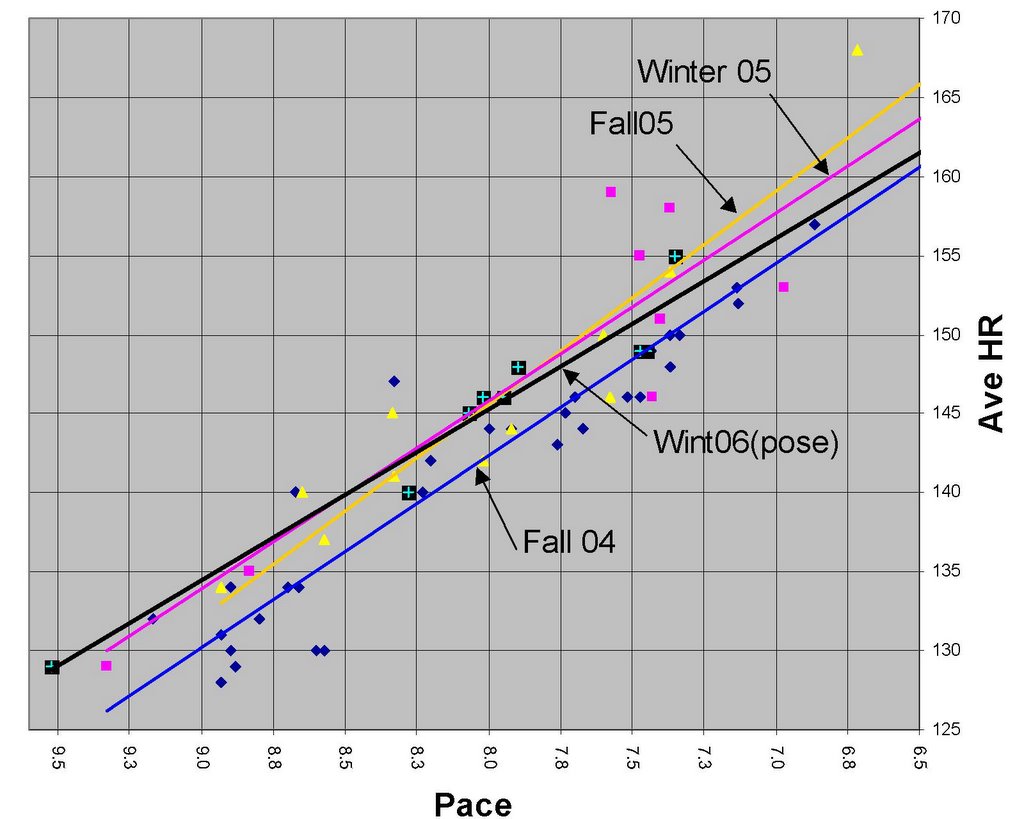
Pose Method Pace vs. Heartrate graph
Running Pace vs. Heartrate Graph
On the graph above, the square, black points are Pose data from my standard, 4-mile run course. All of the other data is the same course using my former heel-strike gait for different periods over the last couple of years. Fall of 2004 is the most efficient so far (I was training a little more then), but the Pose best-fit line is closing in fast.
I've noticed that the pose data reflects lower efficiency the longer I run (not shown on this graph). I think that will become less pronounced as my calf muscles get stronger and my body (and mind) adapt to the new stride.
Posted by Robert Jordan at 8:25 AM 0 comments
Labels: running
Cadence vs. Power Graph
After running cadence vs. power at four different cadenses and then performing confirmation tests on three of them, this is what my cadence vs. power graph looks like:
On the three points that have confirmation data (cadences 60, 70, and 90 rpm) the higher of the two was my second test. An extra couple of weeks fo training might explain the slightly higher numbers. Or maybe I'm just getting more accustomed to a lower cadence, which felt very unusual at first, but feels comfortable now. All the tests were run at a constant heartrate of 150 bpm, which is about 10 bmp above my lactate threshold.
My next step will be to run tests at 55 rpm and 65 rpm to generate more detailed information in the vicinity where my apparent peak lies (I'm guessing 55-60 rpm). After I determine the exact peak, then I'll have to do some real-world tests to see if that cadence is maintanable. It should work well for time trials of 20 to 45 minutes, but might not be great for group rides.
Posted by Robert Jordan at 8:13 AM 0 comments
Labels: physiology, testing
Sunday, January 15, 2006
Museum of Aviation 1/2 Marathon
Yesterday was my first race using the Pose method. Seven friends (which is a huge crowd for my small, rural county) and I drove to Robins Air Force Base to run the Museum of Aviation Half Marathon. I didn't really race, I stayed with a friend, Jamie, at an 8 min/mi pace for the first 10 miles or so. It was windy and pretty cool (about 42 degrees), but the course was very flat. The course is essentially one lap around the base on the exterior patrol road. Jamie and I had an interesting conversation while running the first several miles as we talked with Jim Marshall, our local congressman. He had a good race and we enjoyed speaking with him about all things running.
At mile 8 or 9, my calves started to noticably fatigue. The longest Pose run I'd done was 8 miles, so I was in uncharted territory. At about mile 10, we crested a small hill (one of the few rises on the flat course that could even be termed a hill). Jamie slowed for a drink, and I kept my pace. My calves were so fatigued, that I felt I would not be able to accelerate if I slowed to wait for Jamie to catch up, so I kept going. After another 1/4 mile or so, I gave up on the Pose method for the day. I was happy I'd made it almost 11 miles using it, but could not sustain it.
That's when in interesting thing happend. I guess I began to use some fresh muscles when I changed back to heel striking, or maybe I was just using muscles differently. Whatever the case, it felt like I'd just reclined in a Lazy-boy lounger! My pace shot to about 7 min/mile and I felt very fresh physically and mentally. I finished the race at about a 7 min/mi pace at 1:42:56 and felt quite fresh at the end. Congressman Marshall had pulled away from Jamie and I at about mile 6, but I caught him right before the finish. He probably shaved 30 seconds off my time as I used him for a carrott during the last mile.
Even if unintentionally, I guess I found a new strategy by starting with Pose and finishing with my old-faithful heel-strike when the Pose tank was empty. Whether that will be a long-term strategy, I don't know -- probably not -- but it worked yesterday.
Everyone else in our group, Jamie, Adam, David, Betty Jean, Suzanne, Pam, Cristina had good races also -- there were several PRs in the group. Even though I didn't race the course, I learned a lot about my new stride, had a very good early-season training day, and had a great time!
Posted by Robert Jordan at 2:16 PM 0 comments
Labels: race report, running
Thursday, January 12, 2006
Orca/Half Marathon/Power test confirmation data
- I called FreeFlite bike shop in Buckhead to discuss the purchase of an Orbea Orca. I found out two interesting things. One, it's pronounced Or-bay-a, not Or-bee-a like I thought. Second, the salesman said I'm likely to fit a 51cm Orca. I ride a 56cm Trek 5200 now and it's slightly too small for me, so 51cm doesn't sound right. He said they measure them using an unusual convention. Evidently the owner has a blue Orca just like the one I want. So I'm probably going to ride up there next week and test ride it.
- We (my wife and I and about 5 or 6 friends) are road-tripping to Warner Robins on Saturday morning to Robins Air Force Base to run the Museum of Aviation half marathon. It's a fun race. I ran it two years ago with Abby White, a tri-friend who has moved to Florida. It's a fun, low-key run around the air force base on the patrol road. Quite flat. It's the first time that we've had a group this big going to a race together. It's nice to see that local interest in running is growing. We actually had 9 or 10 people doing a training run on Rock Eagle Road last Saturday. That's pretty unheard-of for around here.
- I'm in the process of doing confirmation runs of my bike cadence vs. power testing data. Originally, I did tests 150 bpm rides at 70 rpm, 90 rpm, 100 rpm, and 60 rpm. My power was consistent (about 175 watts) at 70 at 90 rpm, was about 30 watts lower at 100 rpm, and about 25 watts higher at 60 rpm. The re-tests are slightly higher so far at 60 and 70 rpm, but pretty close to the initial test results. The increase is probably due more to recent training at lower paces and higher intensities than to lack of tesing precision. I'll probably run two more tests, one at 90 rpm and one at 65 rpm to populate the graph a little more densely at the low end. I'm curious to see what 50 rpm would give me, but from a practical standpoint, I don't think it's very useful. If I rode any significant distance at any significant wattage, my knees would probably blow out!
Posted by Robert Jordan at 3:43 PM 0 comments
Sunday, January 08, 2006
Low-cadence cycling
As I've mentioned earlier in my blog, power testing on my computrainer showed me that I produced about 15 to 20 watts more at 60 rpm than at 70 to 90 rpm. My power at 100 rpm was about 15 watts lower then the 70 to 90 range. I've always ridden at about 90, so that was a surprise to me.
I've been trying to train myself to ride at a lower cadence lately on my computrainer rides. Today was the first nice weekend day in a while, so I went out and did a 25-mile ride with my wife at about 17.5 mph. My heartrate was quite a bit below the predicted level based on my heartrate vs. speed graph that I kept from last fall's rides. It could be an anomoly, but I'm looking forward to plotting some more rides to see how they look.
I'm also looking forward to using a lower cadence on some longer rides to see how big the muscular endurance factor kicks in. It might turn out that the lower cadence is much more efficient for me on 20-40 mile rides but might not work for 80-100 mile rides due to the muscular fatigue that sets in. The lower cadence makes the ride seem 'calmer' and more fluid than the higher cadence. Even though those are subjective psychological effects, they might be helpful on difficult rides.
Posted by Robert Jordan at 5:26 PM 0 comments
Labels: skills
Pose Method 8-mile run
My experiment continues... About 4 weeks ago I quit my old running stride cold turkey and started running using the Pose method. It was almost impossible at first. The first time I ran 3 miles I could hardly walk the next day. But I've stuck with it in hopes of increasing efficiency, decreasing the chance of injury, and better using my calf muscles on the run leg of triathlons.
Yesterday I did my first long run using Pose. I ran 8 miles at about an 8 min/mile pace. My heartrate was about 3 bpm below what it was for heel-strike running a month ago. So even though my body is still adapting to the new stride and I have not even begun the video analysis of my stride to make sure I'm really doing the Pose method properly, I've already seen an increase in efficiency. Four weeks ago I though the attemp was futile, but it appears to be working.
When I temporarily switch back to my old heel-striking form, it feels like I'm speed walking compared to my new stride.
Posted by Robert Jordan at 5:19 PM 0 comments
Friday, January 06, 2006
Computrainer modeled course matches real world results
After riding the Silver Comet Trail time trial last weekend, I used the elevation data that my Polar heartrate monitor gathered during the ride and recreated the course profile on my Computrainer. The slopes on the trail are small (most range between 0.1% and 0.8%) because the trail lies on an abandoned railroad bed. I added a 5 mph wind from the west because that is typical for the trail ride.
After setting up the course on the computer, I rode it trying to keep my heartrate at about 147 for the entire 10 miles. I figured that would give me a data point between the 153 bpm and 143 bpm that I got from my real-world rides. The out portion of the ride is much slower than the back stretch becase it's slightly uphill and into the wind. I averaged about 18.5 mph going out, and 22 coming back in with the wind at my back. I think my average power was about 200 watts.
I finished the Computrainer ride at 147 bpm average heartrate and and average speed of 20.0 mph. When I plotted the new data point on my graph of HR vs speed for last weeks ride, it hit dead on the line! So now I have a perfect way to try different strategies to prepare for the time trial in Feburary. Also using the 'race against previous performance' feature, I can see how different strategies (starting out easier, etc.) relate on the course to my other rides.
It's the best possible way to squeeze out all possible speed using my average abilities.
Posted by Robert Jordan at 4:47 PM 0 comments
Labels: testing, time trial
Sunday, January 01, 2006
Silver Comet Time Trial Training
I drove an hour and a half yesterday to meet with my coach and some of his other clients to do some practice time trail work on the Silver Coment Trail, a multi-use trail northwest of Atlanta. It was a fun day and the weather was decent for December, but the trip generated lots of questions by me. Instead of summarizing the whole thing here, I've decided to just post the e-mail that I sent to Tony after the ride. If he answers some or all of my quesitons, then I'll post that here later also. On my first 10-mi out and back TT I averaged 153 bpm and 20.3 mph. My second ride was 143 bpm and 19.2 mph. On both rides, I had to stop and unclip a couple of times due to road crossings, etc.
Tony:
Thanks for organizing the time trial practice yesterday and for keeping the data (I’m sure it got kind of boring after a while). I think I need lots of that type of training, and yesterday gave me a good example of how to set it up in Monticello. It also gave me a good preview of what to expect in the Tundra TT.
There’s lots of stuff below. I apologize in advance for being long-winded, but I have lots of questions.
Yesterday was a strange day for me. The warmup felt great and I enjoyed riding the trail for the first time, and I even ran into a friend of mine who works in Vinings and rides the trail a lot.
The first 10-mi TT felt pretty normal, even though I pushed a little harder than I would’ve when doing a TT at home. I was a little surprised that my speed was not higher – I figured on a flat course, my speed would be higher than what I’m accustomed to in sprint races (maybe the wind and the frequent road crossing contributed?).
But the real surprise was how awful I felt during and after the 2nd ride. No matter how hard I pushed, I couldn’t get my heartrate over about 145 or so – and I had very weak legs. I guess it was because my legs were loaded with lactate from the first ride. But based on my experience I thought I should have been able to ride longer than 30 minutes at the higher heartrate. After the second ride I was completely toast. When you asked me to ride a 3rd time, I couldn’t even consider it because I felt so weak. I think I didn’t eat enough before the ride, because I was shaky and getting hot and cold on the way back. I barely made it back to the Jeep at 14 mph with a wind at my back! Lunch never tasted so good, and 10 minutes later I felt fine again – so that was a good lesson in itself (don’t neglect nutrition just because it’s ‘only’ a training ride). If I had tried to ride a third time trial, I honestly might not have made 17 mph and I would have been camped on the side of the trail begging for Powerbars just to get back home!
Now that you have convinced me that my LT is really in the basement, I’m determined to properly focus my workouts to increase it. (What HR do I divide my LT heartrate by to get my LT %VO2max?) I’ll continue to do the hill repeats that we’ve discussed, and I’ll add some 10-mi TT repeats. What heartrate do you think I should be aiming for on the TT workouts? Based on yesterday, 153 bpm is far too high. Maybe I’ll try doing 10 mi at 145 and see if I can increase my speed on a follow-up 10-mi ride? I’m very interested in discussing how I can use the ‘new’ LT information to better pace myself in olympic and half iron distance races (I guess it’s just all-out in sprints no matter what?).
And lastly:
I took a closer look at my heartrate profiles from last year’s half-iron and West Point races. My average heart rates for the four 45-minute ‘quarters’ of my half-iron ride last year were 154, 149, 145, and 141 bpm (148 overall average). I obviously started quite a bit above LT and paid for it at the end (even though I stayed above LT for almost 3hrs? – I still don’t understand that – and then averaged 152 for the entire run). What would have been the effect if I’d started at 145 bpm or so and held it constant throughout the ride? Would I have had higher average speed on the bike, or similar average bike speed but better legs for the run?
Last year’s West Point oly was similar. In thirds, my average rates were: 155, 151, and 149 bpm (152 overall average).
Again sorry for the long-email, but I really want to learn how to optimize my rather limited abilities.
Robert
Posted by Robert Jordan at 3:01 PM 0 comments
Labels: testing, time trial